
In absolute terms, both types of cars must cut emissions by about 28-29 g/km. But in percentage terms, the lighter 900-kg car must reduce emissions by 27 per cent, while the 1,500-kg car needs a 22 per cent cut. And the target becomes progressively stringent for both -- but, once again, the tightening is sharper for the 900-kg car than for the 1500-kg car.

Passenger vehicle wholesales in India witnessed a marginal growth in May on account of high base effect and muted demand due to general elections. The overall passenger vehicle dispatches from companies to dealers stood at 350,257 lakh units last month as compared to 335,436 in the same month a year ago, registering a growth of 4 per cent.

Prices across all models starting from Eon to Santa Fe has been hiked in the range of Rs 15,000 to Rs 127,000

Hyundai Motor India expects its SUV range to gain further traction in the domestic market with demand for personal mobility gaining momentum post the second wave of COVID-19, according to a senior company official. The company, which already leads the SUV space with models like Venue, Creta, Tucson and recently launched Alcazar, is looking to maintain its lead in the segment which is growing with each passing month.

Besides, Toyota and MG Motor also reported nil sales as they suspended operations even before the imposition of lockdown on March 25 to check the spread of coronavirus. In two-wheeler segment, niche bike maker Royal Enfield said it had zero sales in the domestic market but exported a total of 91 units last month.

Smart positioning, continued communication and a global design language have played a big role, say experts

H S Lheem, president and chief executive officer of Hyundai WIA, part of the Hyundai Motor Group, announced commencement of the company's first plant in India near Sriperumbudur in Tamil Nadu, in which it's injecting a investment of $4 million.

Automobile exports from India in the first six months of the current fiscal year rose 14 per cent year-on-year, led by gains in shipments of passenger vehicles and two-wheelers. According to Siam data, the overall exports in the April-September period stood at 25,28,248 units, up 14 per cent as compared with 22,11,457 units in the year-ago period. "Key markets like Latin America and Africa, which had slowed down for various reasons, have bounced back.

The Securities and Exchange Board of India (Sebi) is set to introduce key reforms aimed at facilitating smoother mega initial public offerings (IPOs). Key among the proposals is a reduction in the quota reserved for individual investors - those applying for less than Rs 2,00,000 per application - from the current 35 per cent to 25 per cent for large IPOs (issue size above Rs 5,000 crore).

Tata Motors, India's third largest passenger vehicle maker, took pole position in the competitive sport utility vehicle (SUV) market in October, reveals the data from industry sources. Riding high on the Punch - the sub-compact SUV offering launched on October 18 - the Tata group flagship sold a record 23,381 units in October, higher than 20,022 units sold by archrival Mahindra & Mahindra, 18,538 units sold by Hyundai Motor India, and 15,931 units sold by Kia Motors India. Utility vehicles - that include SUVs and multipurpose vehicles - accounted for almost one in every two passenger vehicles sold in India in the first seven months of the current financial year, according to the Society of Indian Automobile Manufacturers.

New campaigns rev up their marketing pitch, while new challengers such as Tata Motors with the Zest promise to put up a spirited fight

The move will result in around 25 per cent reduction in overseas shipments from the company's Chennai plant this year at 190,000 units compared to 253,000 units last year.

As other global car makers struggle in India to keep sales consistent, the Korean player has made a heady combination out of design, launches and localisation.

All three employees are recovering fast towards normalcy and as per the safety protocol, essential information was shared with the district health authorities, it added.

M&M also saw its domestic passenger vehicle sales grow by 1 per cent, while Toyota Kirloskar Motor witnessed a decline in its PV sales.

Launched in petrol and diesel in-line options, Elantra holds the potential to dominate over the existing sedan rivals like Chevrolet Cruze, Skoda Laura and Toyota Corolla Altis.

Passenger vehicle dispatches from companies to dealerships witnessed an increase of 1.6 pc year-on-year in January at 399,386 units driven by robust demand for utility vehicles, industry body SIAM said on Thursday. It was the highest-ever passenger vehicle dispatch for the month of January.
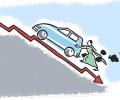
The only silver lining in March's performance -- which otherwise dragged down the financial year's momentum -- was a 6 per cent year-on-year (Y-o-Y) growth compared to March of the previous year. This is largely due to incentives, festival-driven gains, and new launches.
Ashok Kumar Jha will step into a role that BVR Subbu, a powerful and seasoned corporate campaigner, had demitted over a year ago.

Passenger vehicle sales in India touched a record high of 41.08 lakh units in 2023, growing by 8.3 per cent over the previous year driven by SUVs, which accounted for almost half of the total dispatches from manufacturers to dealers. The record sales have been achieved despite an increase in the average price of vehicles to Rs 11.5 lakh last year as compared to Rs 10.58 lakh in 2022. Market leader Maruti Suzuki, Hyundai Motor India, Tata Motors and Toyota Kirloskar Motor reported their best-ever annual sales in 2023.

The entire range of Hyundai's diesel cars - from compact ones to SUV models, including the soon-to-be-launched Aura - will be eco-friendly.

Legal battles initiated by 1,000-odd former employees of the Talegaon plant continue to present a challenge for the acquisition process.

Offering buyers a car that meets their aspirations & lifestyle needs, the Creta became a style icon. The Creta, which was officially launched on Monday, is a global model, created with an investment of more than Rs 1,000 crore.
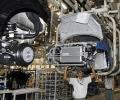
Hyundai Motor and Toyota Kirloskar Motor have announced the suspension of manufacturing operations at their respective plants amid coronavirus outbreak. On Sunday, various automakers like Maruti Suzuki India, Honda Cars, Mahindra & Mahindra and Fiat announced a temporary halt in manufacturing operations at their respective facilities.
Passenger vehicle exports from India increased 43 per cent in FY22, with Maruti Suzuki India leading the segment with dispatches of over 2.3 lakh units, as per the latest data by industry body SIAM. The total passenger vehicle (PV) exports stood at 5,77,875 units in 2021-22 fiscal, as compared to 4,04,397 units in 2020-21. Passenger car shipments saw 42 per cent growth at 3,74,986 units, while utility vehicle exports rose 46 per cent at 2,01,036 units during the last fiscal, the data by the Society of Indian Automobile Manufacturers (SIAM) showed.

It plans to introduce a total of eight products in the country in 2017-20, of which three will be completely fresh while the rest will be new versions of the existing ones
Hyundai Motor India said on Tuesday it will hike prices of its cars across all models between 2.3 per cent by January 2008 owing to rising input and freight costs. The official said the price rise was due to the rising input costs and freight cost. HMIL's product range starts from the flagship Santro, the base model of which is priced at Rs 2,70,000, while its top end Sonata Embera is priced at Rs 15,71,000.
Maruti Alto or Hyundai Eon? The comparison is here!

Every year, carmakers announce at the end of November or December their plans to increase prices of their vehicles by January.
Automobile exports from India rose 15.5 per cent year-on-year in the June quarter with all verticals, barring three-wheelers, recording growth in shipments, according to the latest SIAM data. Overall shipments stood at 11,92,577 units in the first quarter the current fiscal year, as compared with 10,32,449 units in the same period of the last fiscal. Passenger vehicle exports stood at 1,80,483 units in the first quarter, registering a jump of 19 per cent over 152,156 units in the same period last year.

Country's largest carmaker Maruti Suzuki India (MSI) on Monday reported 8.7 per cent increase in total sales in February.

Why is Shailesh Chandra, managing director of Tata Motors Passenger Vehicles and Tata Passenger Electric Mobility, not worried about the competition?

With car penetration of around 22 per 1,000 population, India continues to be a big opportunity to sell cars, especially in rural areas.

Maruti Suzuki India (MSI) on Monday reported a 29.1 per cent rise in total sales in October.

Other players who have declared no production days in the recent past, and during this month, include Mahindra & Mahindra, Maruti Suzuki, Hero MotoCorp, Bosch, Jamna Auto, Wabco and Sundaram-Clayton.
It seems the Korean carmaker Hyundai Motors has pulled up its socks to conquer every bit of premium car segment.

Among the cars unveiled at the Auto Expo on Wednesday was Mahindra and Mahindra's e-KUV for Rs 8.2 lakhs ex-showroom Delhi. With a single charge range of 150 km and a 55 min fast charging upto 80 pc, it was both a head-turner and a conversation-starter.

The Chennai facility will continue to service Indian and non-European markets. In July 2009, Hyundai India's managing director H S Lheem had said the company was planning to move production to Turkey, the Czech Republic or Slovakia.

Lineup includes a family compact car, hybrid, SUV and others.

The Ministry of Heavy Industries announced on Tuesday that it has received bids from seven players for the re-bidding tender of the 10 gigawatt-hour (Gwh) tranche of the Advanced Chemistry Cell (ACC) manufacturing production-linked incentive (PLI). "The list of bidders (in alphabetical order) who have submitted bids in response to this tender are ACME Cleantech Solutions, Amara Raja Advanced Cell Technologies, Anvi Power Industries, JSW Neo Energy, Reliance Industries, Lucas TVS, and Waaree Energies for a cumulative capacity of 70 Gwh," the ministry said in a statement. After the re-auctioning for the manufacturing unit was announced in January, the pre-bid meeting was held on February 12, the ministry said.
